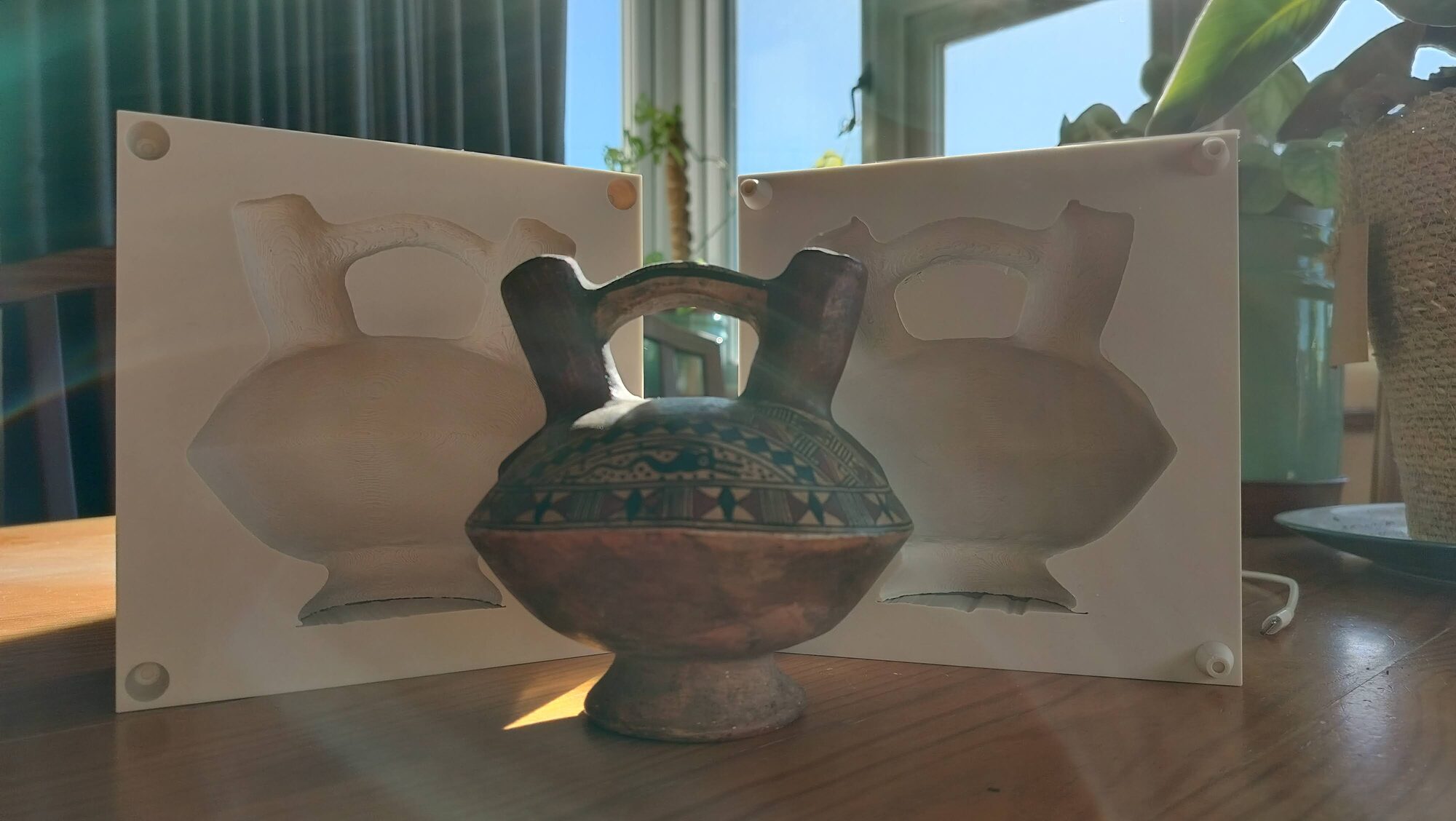
The scan we take for an object's 3D listing already records its exact shape. We use that same scan to print a two-part case with a cavity that matches the object. It's closer to a watch box than to packing: the lot leaves the saleroom already boxed and ready for the shipper, and the case stays with the object for as long as the buyer owns it.
Many salerooms don't pack or ship. Once the hammer falls, the buyer has to arrange a packer, and the packer has to protect an object they've never handled with bubble wrap, foam and a cardboard box. That works well enough on a plain shape. A vessel with spouts, a handle, a narrow foot or a thin rim is harder, because those are the parts most likely to break, and they're also the hardest to brace by hand.
Museums solve this by hand-carving foam cavity packs for each object they lend. It works, but it takes a skilled person hours per object, so it's normally kept for loans and exhibitions. The Keepsafe Box gives the same kind of fitted protection to the lots that deserve it at auction, without anyone carving foam by hand.
We capture the object once, during the same session that produces its interactive 3D listing. You don't need a second visit or extra handling.
Our software turns the scan into a two-part case shaped to the object, ready to print.
Both halves are 3D printed with locating pins and sockets in the corners, so they only close one way and line up the same way every time.
The object goes into its half, the case closes around it, and the closed case goes into an ordinary carton for the shipper. Nothing has to be wrapped by hand.
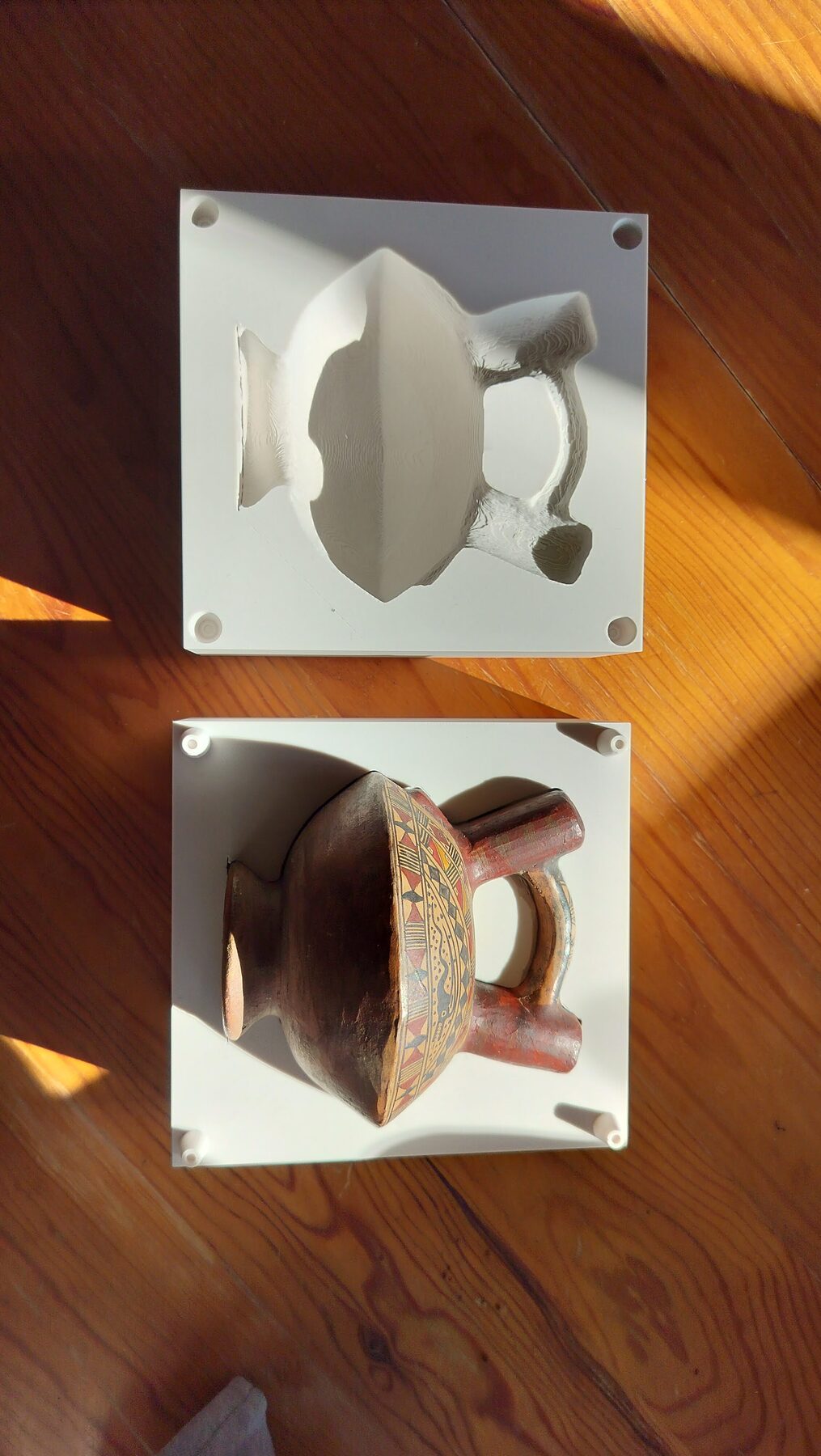
This vessel is a hard shape to pack: two spouts, a bridge handle between them, a wide body and a narrow foot. A generic box with foam leaves the spouts and the handle to take the knocks. Here, each half holds the whole outline, including the gap under the handle, so the object can't shift or turn inside.
The four pins and sockets line up both halves, so nobody has to judge the fit when closing it, whether that's the packer, the courier or the buyer.
The cavity comes from the object's own scan, not from a size chart, so even irregular shapes are held all the way round.
The capture that makes the 3D listing also makes the box. There's no second visit and no extra handling of the object, and the box is ready to go out with the lot when it's collected.
Packing material goes in the bin. This case is kept: it's flat-sided, so irregular objects stack on a shelf like books, and the object is ready to move or sell on whenever it's needed. For an auction house, that means a case with your name on it on the buyer's shelf for years.
Valuable, fragile pieces: ceramics, glass, figures and sculptural objects where the buyer has spent enough that the object deserves its own case. We mainly work with auction houses on their specialist sales, and with dealers who ship to their clients.
By the value of the lot, in fixed bands, not by the size of the box, because a case for a £20,000 piece does a different job from one for a £2,000 piece. Auction houses buy at a trade rate and add the case to the buyer's invoice, alongside storage and transfer, keeping the difference. We can also set your house's name into the lid.
Yes. The cases are printed in PLA, a stable, inert plastic, so the object can stay in its case between moves. Because every case is a flat-sided block, a collection of awkward shapes stacks neatly on ordinary shelving, and each object stays in its own fitted cavity.
No. The closed case goes inside a standard outer carton, and your usual carrier collects it. Because the hardest part of packing is already done, the shipper has much less work and much less risk.
Most vessels, figures and sculptural pieces work with a two-part case, including awkward ones like the vessel above. Very complex or deeply hollowed forms may need a three-part case or some added lining, and we'll tell you before we print anything.
Start with one specialist sale. Pick ten to fifteen of the most fragile, valuable lots, the ones you'd least like to hand to a courier. We'll scan them, print their cases, and send you our price bands before you commit to anything. Then you'll see how many buyers take the case on their invoice. Email [email protected] and tell us what you have in mind.
Want to see the 3D capture side as well? Browse the gallery.